.png)

Double Category Error ~ David vs Jesus

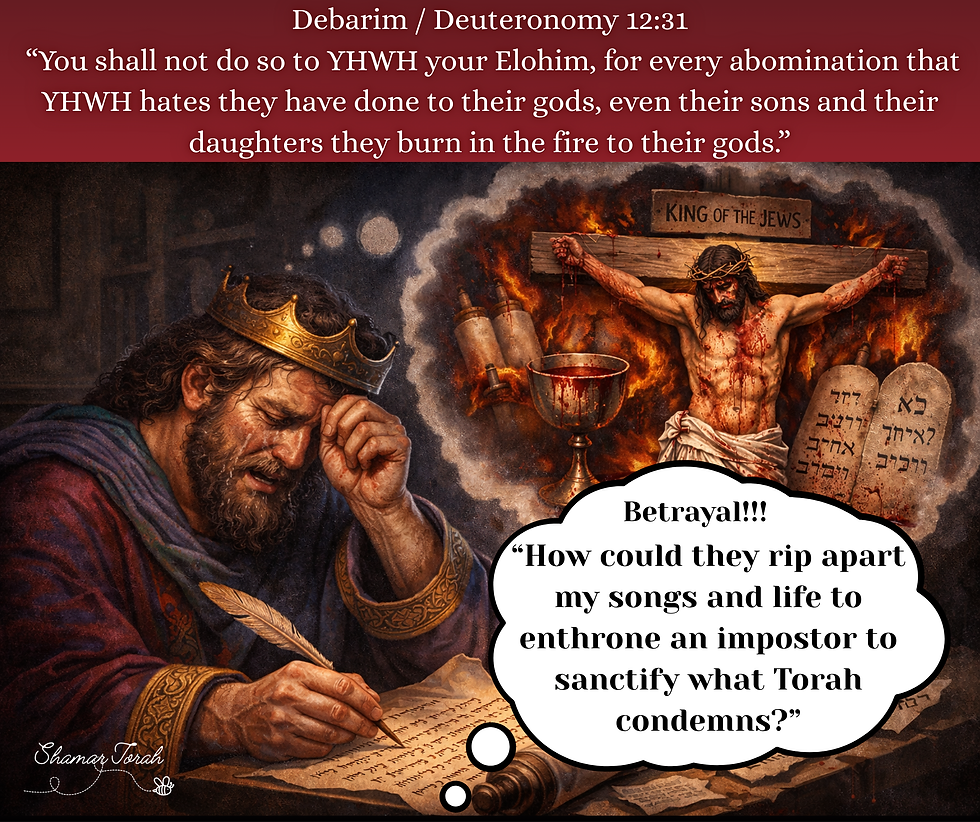
The Jesus mythos depends on two simultaneous false moves: the removal of Mashiach from David and the insertion of human sacrificial theology into a role where it does not belong. Removing Mashiach from David is not fulfillment of prophecy - it is its negation, compounded by a theology Torah explicitly condemns.
Tanakh itself defines who Mashiach is, how Mashiach is identified, and whether that role can be transferred, replaced, or reinterpreted. If Tanakh is allowed to speak on its own terms, without importing later theological frameworks, it consistently identifies one historical individual by name, lineage, anointing, covenant, and outcome. That individual is David / Dowyd ben Yishai.
Tanakh never treats Mashiach as an abstract idea or a future riddle. Mashiach is a concrete title applied to identifiable individuals, and David is repeatedly and explicitly called YHWH’s Mashiach in real historical contexts (1 Samuel 24:6; 26:9; 2 Samuel 22:51; Psalm 18:50). This is not typology or anticipation. David is identified as Mashiach and as YHWH’s son during his own lifetime. Torah does not operate with placeholder messiahs or symbolic stand-ins.
That identification is reinforced by the covenant itself. YHWH swears an unconditional oath to David’s house: his seed, his throne, and his kingship are established forever (2 Samuel 7:12–16; Psalm 89:3–4). The text goes out of its way to state that this covenant will not be annulled, revoked, or transferred, even if discipline is required (Psalm 89:30–37). Any theology that removes Mashiach from David necessarily violates the plain language of YHWH’s sworn oath.
When later prophets speak of the anointed king, they do not introduce a new or anonymous figure. They name David directly. Jeremiah speaks of a righteous branch raised up for David (Jeremiah 23:5). Ezekiel repeatedly identifies David as the shepherd-king YHWH will establish over His people (Ezekiel 34:23–24; 37:24–25). Hosea likewise says Yisrael will return and seek YHWH and David their king (Hosea 3:5). This is covenantal continuity. Tanakh does not anticipate a non-Davidic, Davidic-descendant, or post-Davidic messiah to replace David.
The same principle governs the so-called suffering texts. The primary suffering texts appear in first-person psalms explicitly attributed to David by superscription and internal voice (Psalm 22; Psalm 69; Psalm 41). Betrayal by a close companion aligns directly with Achitophel (Psalm 41:9; 2 Samuel 15:12), but the archetype of intimate betrayal continues to play out in every abuse and misportrayal of David’s prophetic songs-used to cast him into religious roles and rituals he systematically opposed. Public mockery and scorn appear in David’s own words (Psalm 22:6–8) and persist today as David’s message is used to violate the covenant of YHWH rather than being read within its intended context. Violent assault and piercing language describe persecution and bodily harm, not ritual sacrifice (Psalm 22).
This misreading continues today by manipulating David’s writings and attributing them to a Jesus/Yeshua figure who violates everything promised to David and all that David represents. Abandonment, exile, and eventual restoration map cleanly onto David’s documented life (1 Samuel 19–26; Psalm 13; Psalm 30), and are also written prophetically for the last days, when David’s reputation is restored in its proper context-firmly dismantling the human sacrificial narratives wrongly attached to his psalms. These texts are not predictive riddles detached from their speaker. They are covenantal testimony spoken by the anointed king himself, echoing throughout time.
Isaiah must be read within that same covenantal frame. Isaiah 52 through 54 is a continuous literary unit that moves from humiliation, to vindication, to restoration under an eternal covenant. Isaiah 54, written for the end times, explicitly invokes the sworn covenant of peace and parallels it with the covenant made with David (Isaiah 54:9–10). Reading Isaiah 53 as if it is not David, while using it to prop up a human-sacrifice cult centered on Jesus Christ, fractures both the literary flow and the covenantal logic of the text.
This is where the Jesus narratives introduce a double category error. First, they misappropriate David’s life, voice, and covenantal role. Psalms written in the first person by David are lifted and reassigned to another figure, despite their attribution and historical grounding (Psalm 22 superscription; Psalm 18 superscription). Suffering that belongs to the anointed king of Yisrael is detached from him and transferred to someone else, effectively erasing the one man Tanakh explicitly names as Mashiach. This is an error David clearly foresaw-one that caused him profound anguish, which he prophetically recorded in the very psalms later used to create the myths that betray him.
Second, and more severely, those narratives inject human sacrificial theology into the Mashiach and suffering-servant framework. Torah categorically rejects human sacrifice, explicitly and without exception (Deuteronomy 12:31; Deuteronomy 18:10; Leviticus 18:21). YHWH states plainly that such practices were never commanded and never entered His mind (Jeremiah 7:31; Jeremiah 19:5). Psalm 40 rejects sacrifice as the mechanism of reconciliation and instead emphasizes divine discipline, corrected behavior, and trust of a good outcome by depending on YHWH’s mercy (Psalm 40:6–8). To redefine Mashiach as a human sin-offering is not a fulfillment of Torah categories but a direct violation of them.
This exposes the compounded distortion. Mashiach is misdefined, and sacrifice is misused. Mashiach does not mean savior. Tanakh reserves salvific language exclusively for YHWH (Isaiah 43:11; Isaiah 45:21). Mashiach is a king-an anointed ruler charged with governance, justice, and covenantal continuity-not a man-god whose death pays a sin-debt. That entire framework is foreign to Torah.
Roman execution narratives do nothing to repair this error. “King of the Jews” was Roman mockery, not Judean recognition. Rome crucified claimants and mocked subject peoples; it did not validate Torah prophecy (compare Psalm 2:1–3). Obadiah describes the future fate of Edom for its betrayal of Yahudah and its enjoyment of the calamity of the descendants of Ya’aqob, its brother. To use what Rome produced to invalidate Torah is to carry forward the legacy of Edom-to stand in opposition to the family of Elohim and the descendants of Abraham, Yitshaq, and Ya’aqob.
In summary, when Tanakh is allowed to define its own categories, the conclusion is consistent and unavoidable. David is named, anointed, sworn to, afflicted, vindicated, and eternally covenanted (2 Samuel 7:16; Psalm 89:36–37). Tanakh never authorizes a second messiah, a replacement messiah, or a sacrificial messiah. So, like I stated in the beginning, the Jesus mythos depends on two simultaneous false moves: the removal of Mashiach from David and the insertion of human sacrificial theology into a role where it does not belong. Removing Mashiach from David is not fulfillment of prophecy - it is its negation, compounded by a theology Torah explicitly condemns.


Comments